Note-taking apps on smartphones have made capturing ideas as easy as speaking them into the air. But for engineers, nothing beats putting pen to paper and sketching them out by hand.
One day in 1980, Burt and Dick Rutan imagined an airplane that could make it around the world and never stop for fuel. By the latter half of the 20th century, it seemed that all the major aviation records had been set except one: the longest non-stop flight.

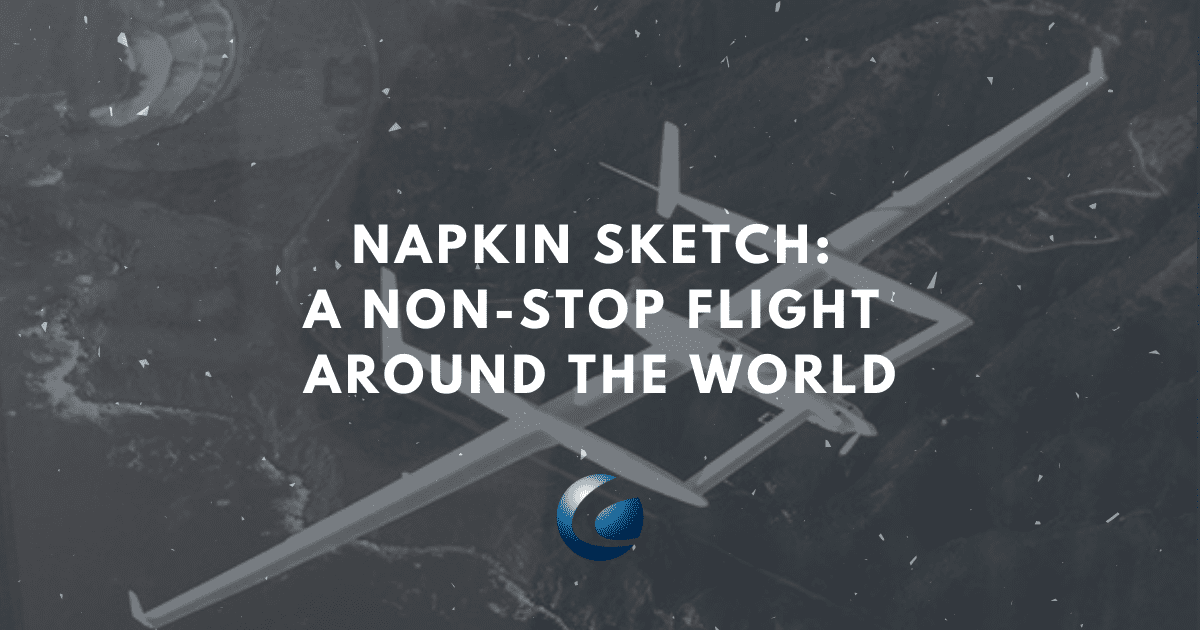
In 1981, the brothers sat down to lunch with aviator Jeana Yeager. There, on a napkin, they sketched what would eventually become the record-breaking Rutan Voyager.
How was the Rutan Voyager designed as a flying fuel tank?
The Rutan Voyager was almost more of a fuel tank than an airplane. Using lightweight, graphite honeycomb materials, the empty Voyager weighed less than 1,000 pounds. It was then filled with over 7,000 pounds of fuel.
In a 747, that’s barely enough to cover the 400 miles from Atlanta to Tampa. This plane needed to fly nearly 25,000 miles.

The Rutan Voyager had 17 fuel tanks: eight on each wing and one in the middle. Because fuel accounted for over 73 percent of the weight, it took the craft more than two minutes to get down the runway before taking off.
Once it was finally airborne, the flight plan was dictated by nature.
What challenges did the Rutan Voyager face during its 9-day, 3-minute, 44-second flight?
There was only about a quarter-inch of material that separated the pilots from the elements outside. Every bit of turbulence was a threat to the craft, so the flight path was made up as they went. It mostly cruised at a mere 8,000 feet, but would occasionally climb as high as 20,000 feet to avoid storms.
Typhoon Marge in the Pacific was both a threat and a boon to the mission. Meteorologists were able to help the pilots navigate around the storm and also take advantage of the “slingshot” effect from the added tailwinds.
While storms over Africa and near Brazil posed a significant challenge, it was a blockage in a fuel pump that almost doomed the flight on the final day. Air pockets stopped one of the engines and The Voyager dropped 5,000 feet. Pilots Yeager and Rutan were able to restart a front engine, level the plane off at about 3,500 feet, and land a few hours later right where they began at Edwards Air Force Base. They had just 100 pounds of fuel left to spare.
How does Custom Powder turn a sketch into a creation for engineering solutions?
We love this story because it reminds us what can happen when engineers think big. Customers have come to us trying to solve a problem other companies passed on. Sometimes the invention results in “the strangest thing anyone has seen,” but it gets the job done.
What can we invent for you? Call us at 417-868-8002 or use our contact form. We literally fly around the world when people need us!
To hear more about the art of engineering, sign up for our newsletter.