Screenshot

Built in the U.S. Means Fewer Tariff Surprises

When you’re buying custom powder handling or containment equipment, price is only part of the story. What really puts pressure on a project is when costs shift after the quote, lead times get shaky, or sourcing issues start creeping into the schedule. That is why where your equipment is built matters.

At Custom Powder Systems, we give our customers a practical advantage: our systems are designed, fabricated, and supported in the United States. We also build with approximately 99% U.S.-sourced materials, with only the occasional component imported when needed. That means our customers are far less exposed to tariff-related volatility than they would be with equipment tied to a heavily imported supply chain. The result is a more stable path for budgeting, planning, and purchasing.

For procurement teams and project managers, that matters in real terms. Less tariff exposure helps reduce the chance of sudden cost swings. Domestic sourcing can also make lead times more predictable and communication more direct. Because we design and build here in the U.S., we are able to offer customers faster lead times, direct access to engineering support, and confidence in American-made quality and compliance.

That advantage is even stronger because we are not just a domestic fabricator. We specialize in tailored powder handling and containment system solutions for chemical, pharmaceutical, food, and other manufacturing environments. Our focus is on custom systems designed around each customer’s process, not a one-size-fits-all machine pulled from a catalog.

So the benefit is not only that our equipment is built here. It is built here for your process. When a system is custom-engineered and domestically built, our customers get a better fit and fewer outside variables working against the project at the same time. That combination helps reduce risk on both sides of the job: process performance and procurement stability.

From Springfield, Missouri, we design and manufacture equipment for companies that cannot afford unnecessary surprises in containment, handling, or project execution. In a market where tariffs and sourcing shifts can throw off an otherwise solid plan, working with a U.S.-based partner is not just a preference. It is a practical advantage.

If you’re planning a new containment or powder handling project, we offer a more stable path forward: custom equipment, built in the United States, with far less exposure to tariff-related disruption.

ASME U-Stamp importance highlighted visually

What ASME U-Stamp Accreditation Really Means (and Why Buyers Ask for It)

The question behind the question

When a buyer asks, “Are you ASME certified?” they’re rarely asking for a badge. What they’re really asking is:

  • Can I trust this vessel to perform safely for the long haul?
  • Is the fabrication process controlled and repeatable?
  • If something goes wrong years from now, can we track exactly what happened and why?
  • Has anyone outside the shop verified it was built the right way?

That’s where ASME accreditation comes in.

ASME in plain language

ASME (American Society of Mechanical Engineers) publishes widely adopted codes that define how pressure vessels must be designed, built, welded, inspected, and documented.

The biggest difference between “standard fabrication” and “ASME work” is that ASME requires you to prove what you did—with documentation that’s detailed enough to trace critical aspects of the build long after the vessel leaves the shop.

In other words: it’s not just about building it. It’s about being able to show your work.

What “Section VIII U-Stamp” means

For pressure vessels, a common accreditation is:

  • ASME Section VIII – the rules for building pressure vessels (non-boiler)
  • U-Stamp – the stamp applied to qualified pressure vessels built under Section VIII

Section VIII work applies to vessels intended to hold pressure above 15 PSI and/or negative pressure (vacuum) applications. The stamp is a signal that the vessel was built under code and met the requirements for documentation, inspection, and control.

What “Section IX” has to do with it

Pressure vessels are only as good as the welds that hold them together. ASME Section IX governs welding procedure qualification and related requirements. It helps ensure weld quality is not dependent on “who happened to weld it that day,” but is consistent, validated, and repeatable.

Why third-party inspection matters

One of the most important points from your transcript is that ASME work isn’t just “checked in-house.”

A third party—through an Authorized Inspector (AI)—provides independent oversight. That inspector:

  • Reviews key documentation (including design calculations in many cases)
  • Verifies that the build is following the rules of the code
  • Adds confidence for the customer that it wasn’t simply “approved internally”

For buyers, this matters because it reduces risk. It’s one thing for a shop to say “we build good vessels.” It’s another thing to have an outside authority confirm the vessel was built under a known standard.

The big value: traceability

ASME work is built around traceability:

  • Materials are tracked
  • Weld procedures are documented
  • Inspection records are captured
  • Non-destructive testing (NDE) results can be included as required

That traceability is what makes ASME so attractive to regulated industries like pharma and food & beverage, where documentation is often just as important as the equipment itself.

“Built to code” vs “Stamped”: what’s the difference?

You’ll often hear two options:

1) Built to code (not stamped)
This typically means the shop follows code-based methods and documentation practices for the build, but the vessel is not registered/stamped as an official code vessel.

2) Stamped (U-Stamp)
This is the full code vessel path. It usually involves:

  • More formal documentation
  • Authorized inspection involvement
  • Additional review and verification steps
  • A higher overall project cost

So yes—a stamped vessel typically costs more. Not because it’s gold-plated, but because there are more checks, more documentation, and more stakeholders required to meet the code requirements.

How ASME helps customers—and the shop

From a customer standpoint, ASME helps with:

  • Reduced safety and compliance risk
  • Stronger commissioning/qualification documentation
  • Long-term accountability and traceability

From a shop standpoint, ASME can expand where the company can compete:

  • More projects in regulated industries
  • More complex vessel applications
  • More trust in competitive bid scenarios

And in regions with lots of stainless and vessel fabrication, buyers often use ASME as a screening factor because it’s hard to obtain—and even harder to maintain.

Is ASME important to your equipment purchase

ASME accreditation isn’t a marketing line. It’s a manufacturing discipline.

ASME accreditation is ultimately about reducing unknowns. It gives you a build standard you can point to, a documentation trail you can rely on, and an outside set of eyes that helps ensure the vessel you receive matches the requirements you specified. Whether you’re handling powders in a regulated environment or you simply want tighter control over quality and traceability, the right approach—built to code or fully stamped—can save time, risk, and rework down the road.

If you’re planning a new vessel or upgrading an existing process at Custom Powder Systems, our team can help you decide what level of code compliance makes the most sense for your application. Tell us what you’re containing (material type, pressure/vacuum needs, and your industry requirements), and we’ll walk you through the best path—no overbuilding, no guesswork—just the right solution for your process.

Comparison of containment solutions

Isolator vs. Downflow Booth: Choosing the Right Containment Solution

Isolator vs. Downflow Booth: Choosing the Right Containment Solution

When planning a new process or upgrading an existing one, the question is not only how to handle powder safely, but also:

For many facilities, this decision centers on a key choice: Is a downflow booth sufficient, or is an isolator required—and in some cases, is a combination of both the best approach?

Shared Purpose: Containment and Protection

Both downflow booths and isolators are designed to:

  • Reduce airborne exposure to powders and aerosols
  • Help facilities meet Occupational Exposure Limits (OELs) for potent compounds
  • Support regulatory expectations in pharmaceutical, biotech, chemical, and related industries

In practical terms, both technologies aim to safeguard people, product, and environment. They simply do so at different levels of containment:

  • Downflow booth: An open, controlled workspace
  • Isolator: A fully enclosed, sealed workspace

The appropriate choice depends on material potency, how the product is handled, and whether sterility is required.

Downflow Booths

A downflow booth is a walk-in work area in which clean, filtered air is supplied from the ceiling and drawn downward past the operator into low-level extraction grilles. This controlled airflow pattern directs dust and particles away from the operator’s breathing zone and into HEPA filters. 

CPS downflow booths are typically:

  • Self-contained systems with integrated blowers, HEPA filtration, controls, and lighting
  • Designed to provide a safe working environment for bulk powder handling, sampling, weighing, and dispensing
  • Used to protect both operators and the surrounding facility from airborne powders during open handling operations 

Typical Applications for Downflow Booths

Downflow booths are often selected when open access to the product is necessary and strong containment is still required. Common uses include:

  • Weighing and dispensing APIs and excipientsSampling from drums or containers
  • Splitting or charging batches into smaller containers
  • General open transfers where powder dust may be generated 

CPS designs downflow booths to meet targeted OELs for medium- to higher-potency compounds, frequently suitable for OELs down to approximately 50 – 100 µg/m³ (possibly lower) in non-sterile operations, depending on the specific process and controls in place.

When a Downflow Booth Is Appropriate

A downflow booth is often a suitable choice when:

  • The product is potent but not ultra-high-potency
  • The process is non-sterile and does not require aseptic conditions
  • Operators require frequent, direct access to open containers
  • An existing room needs to be upgraded without installing a full cleanroom or isolator
  • A cost-effective, flexible containment solution is needed to support multiple workflows

Isolators

An isolator is a fully enclosed workspace with rigid, transparent walls, glove ports, and closely controlled airflow and pressure. Operators work through glove ports, without direct physical contact with the product.

CPS aseptic isolators, developed in collaboration with ICS, are designed for low OEL and high-containment applications, particularly where both product sterility and operator protection are critical.

Key characteristics of isolators include:

  • A sealed, rigid enclosure equipped with glove ports
  • Internal pressure control (negative pressure for potent/toxic materials, positive pressure for aseptic product protection)
  • Integrated decontamination systems, including options such as vaporized hydrogen peroxide (VHP)
  • Capability to maintain clean air conditions around ISO 5/Class 100 or better, depending on configuration

Typical Applications for Isolators

Isolators are typically selected for the most demanding containment and sterility requirements. Common applications include:

  • Final weighing and dispensing of highly potent APIs (HPAPIs)
  • Sterile sampling, compounding, or quality control testing
  • Cytotoxic or hormonal product handling
  • Aseptic fill-finish and sterile material transfer
  • Hazardous chemical handling where exposure must be maintained below 1 µg/m³ or at even lower OELs

CPS has also integrated isolators into larger automated systems, such as lifting drums into decontamination and delidding isolators, then discharging material through a screener into a blender vessel. These solutions combine high-level containment with notable gains in efficiency and operator safety. 

When an Isolator Is the Preferred Option

An isolator is typically the better choice when:

  • The material is ultra-potent, cytotoxic, or highly sensitizing
  • Product sterility is as important as operator safety (for example, aseptic manufacturing)
  • The target OEL is below 1 µg/m³, or very strict containment performance is required
  • Any operator exposure, even brief, is unacceptable
  • A fully closed system is required to tightly control air quality, pressure, and decontamination 

Comparing Downflow Booths and Isolators

The decision between a downflow booth and an isolator can be approached through a few key questions:

1. Material Potency

  • Moderate to high potency, non-sterile operations: Often suitable for a downflow booth.
  • Highly potent / HPAPIs / cytotoxic materials: Usually require an isolator. 

2. Sterility Requirements

  • No sterility requirement; focus is on operator and room protection: A downflow booth or other general containment solution may be appropriate. 
  • Aseptic or sterile conditions are required: An isolator (and potentially RABS or specialized aseptic systems) is typically the natural choice. 

3. Degree of Process Openness

  • Frequent manual manipulation and open handling: Downflow booths provide open access and good ergonomics while maintaining strong protection. 
  • Limited access and tightly controlled, defined steps: Isolators perform well in these environments, especially when integrated with automated transfers or robotics. 

4. Facility Context: Retrofit vs. New Build

  • Upgrading an existing non-sterile room: A downflow booth can often be installed as a self-contained upgrade with minimal changes to the building structure. 
  • Designing a new high-containment or aseptic suite: A combination of isolators, downflow booths, and custom transfer systems may be used to achieve a fully integrated solution.

In many cases, the optimal solution is not a single technology, but a carefully designed combination—for example, using an isolator for high-potency weighing that feeds into a downflow booth area where less potent blends are packaged or kitted.

How Custom Powder Systems Supports the Decision

Selecting between a downflow booth and an isolator involves more than comparing specifications. It requires a clear understanding of the entire process, including:

  • The materials handled today and those anticipated in the future
  • How material moves from receipt to finished product
  • Where the greatest exposure risks, bottlenecks, or cleaning challenges occur

CPS specializes in custom powder handling and containment systems, including downflow booths, isolators, IBCs, transfer systems, and fully integrated process lines.

We also work closely with Integrated Containment Systems (ICS), our sister company dedicated to isolators, gloveboxes, and specialty enclosures. Together, we design solutions that balance containment performance, ergonomics, cleanability, and day-to-day workflow. 

Next Steps

If your team is evaluating whether an isolator, a downflow booth, or a combination of both is appropriate for your application, CPS can assist by:

  • Reviewing your OEL targets and process steps
  • Identifying where each containment technology fits most effectively
  • Helping determine whether a booth, an isolator, or a hybrid approach offers the safest and most economical path forward

When you are ready, sharing a process sketch, current challenges, and target OELs will allow CPS to help translate your requirements into a practical, right-sized containment strategy.

equipment

We Don’t Just Build Equipment

At Custom Powder Systems, we believe manufacturing equipment should do more than function. It should solve problems. Whether you’re navigating strict containment requirements, managing complex material handling workflows, or launching a new line of high-potency APIs, we don’t just deliver stainless steel and schematics—we deliver peace of mind.

As a domestic supplier, Custom Powder Systems proudly designs, fabricates, and supports all of our systems in the United States. This gives our clients faster lead times, direct access to engineering support, and confidence in American-made quality and compliance.

Because at the end of the day, you don’t need equipment.
You need a solution.

From Problem to Process: Our Engineering-First Approach

Most equipment vendors ask, “What do you need us to build?”
We start by asking, “What problem are you trying to solve?”

Our engineering process begins with understanding your product, your process, and your compliance demands. Then, we design and fabricate systems that are purpose-built for your environment. This often means integrating containment, automation, ergonomic access, and cleaning protocols into one seamless solution.

Examples of our solution-first thinking:

  • Turning a crowded, multi-vendor process into a compact, CIP-ready production line
  • Designing a modular downflow booth that adapts to new product launches
  • Engineering IBC transfer systems that achieve sub-microgram OEL compliance

It’s Not Just What You Build. It’s How You Build It.

Our expertise spans a range of systems—including:

  • Downflow Booths
    Designed with airflow precision and operator access in mind, our booths meet ISO classifications and OEL targets for safe powder handling.
  • Isolators & Containment
    Custom-built for cytotoxic, hormonal, and sterile applications—designed to be ergonomic, cleanable, and easily integrated with upstream/downstream equipment.
  • IBC Blending and Transfer Systems
    Built for accuracy and hygiene, our IBCs and blending stations are configured to reduce dust, eliminate manual handling, and maximize space.
  • Custom Lifts & Manipulators
    Engineered to move heavy materials with ease and safety—tailored to facility layouts and operator workflows.

Every weld, every interface, and every component is built for performance, compliance, and reliability. We don’t do off-the-shelf. We do on-the-mark.

Compliance Isn’t Optional. And Neither is Ingenuity.

In regulated industries, there’s no margin for error. Whether you’re preparing for an FDA audit, scaling up high-potency production, or upgrading for ATEX compliance, our systems are designed to exceed expectations—because you can’t afford downtime, cross-contamination, or guesswork.

We engineer for:

  • 21 CFR Part 11 compliance
  • cGMP environments
  • Hazardous material zones
  • High-containment OEB 4–6 environments

And we back it all with documentation, validation support, and a collaborative engineering process that puts your team in the driver’s seat.

Your Partner in Innovation

We’re not a fabricator with a catalog. We’re an engineering partner who listens first, designs second, and builds third. Whether you’re in pharmaceuticals, nutraceuticals, specialty chemicals, or food processing—Custom Powder Systems is here to help you transform your challenges into high-performing, compliant solutions.

We build it right because we build it for you.

Containment 101

Containment 101: How to Keep Your Facility Compliant and Safe

Understanding Downflow Booths, Isolators, and Custom Containment Solutions—And How to Meet OEL Challenges Head-On


In high-stakes industries like pharmaceutical, biotech, and chemical manufacturing, managing the risks of potent compound exposure is essential. Custom Powder Systems specializes in the design and engineering of containment solutions that help clients meet strict Occupational Exposure Limits (OELs) while maintaining productivity and compliance.

As a domestic supplier, Custom Powder Systems proudly designs, fabricates, and supports all solutions in the United States—offering faster communication, responsive service, and complete control over quality and timelines.

We also collaborate closely with our sister company, Integrated Containment Systems (ICS), to deliver complete, end-to-end solutions for high-containment environments. ICS enhances our capabilities by focusing on the development of isolators, gloveboxes, and specialty enclosures tailored to critical applications.

This guide breaks down three core technologies—downflow booths, isolators, and custom systems—and how they address common challenges in regulated environments.


Downflow Booths: Flexible and Effective Containment

Custom Powder Systems’ downflow booths are ideal for handling dust-generating processes such as weighing, dispensing, or sampling APIs. These booths use unidirectional (laminar) airflow, HEPA filtration, and low-level extraction to protect both the operator and the surrounding environment.

Key Features:

  • Modular stainless-steel construction with powder-coated interiors
  • HEPA or ULPA filtration for particle capture
  • Airflow design maintains ISO Class 5–8 conditions
  • Available with integrated weighing stations and ergonomic work surfaces

Best suited for:
OEL targets down to 1 µg/m³, suitable for non-sterile operations that require open access.

Advantage:
Compared to full enclosures, downflow booths offer operational flexibility, faster access, and lower capital expenditure—all while achieving excellent containment performance for medium-potency compounds.


Isolators: Maximum Protection for Highly Potent Compounds

When dealing with HPAPIs (highly potent active pharmaceutical ingredients) or cytotoxic materials, isolators are the gold standard. Custom Powder Systems designs both negative and positive pressure isolators depending on the containment or sterility requirement.

Design Attributes:

  • Fully sealed environments with glove ports
  • Integrated decon systems for aseptic cleaning
  • Internal pressure differential controls
  • Optional vaporized hydrogen peroxide (VHP) sterilization

Typical Applications:

  • Final weighing of HPAPIs
  • Sterile material transfer
  • Aseptic sampling or QC labs

With containment capability <1 µg/m³, isolators are engineered to protect both personnel and product without compromise.


Custom Systems: Engineered for Specific Process Demands

Every process is different. That’s why Custom Powder Systems offers engineered solutions tailored to individual client needs—from transfer systems to lift-and-seal devices, and IBC blending enclosures.

Every process is different. That’s why Custom Powder Systems offers engineered containment solutions tailored to individual client needs—from transfer systems to lift-and-seal devices, and IBC blending enclosures.

Examples include:

  • Split Butterfly Valve (SBV) charging systems
  • Contained drum-to-IBC transfers
  • Lift-assist isolator integrations
  • Contained tablet dedusters or blenders

Process-specific benefits:

  • Seamless containment during powder charging/discharging
  • CIP/SIP compatibility for hygiene-critical operations
  • Compact footprints designed to retrofit existing facilities

How We Solve Common OEL Compliance Challenges

1. Inconsistent Airflow or HEPA Efficiency
We integrate real-time airflow monitoring and redundant HEPA filtration to ensure consistent negative pressure and ISO classification—even during high-traffic operation.

2. Difficult-to-Clean Surfaces
All containment systems are designed with cleanability in mind: smooth welds, sloped surfaces, and CIP-ready connections minimize risk and downtime.

3. Cross-Contamination Risks
Our closed transfer systems—like IBC charging stations with vacuum conveying or split-valve containment—prevent powder breach during critical transfer points.

4. Operator Fatigue or Workflow Disruption
Human factors are considered in every design, from ergonomically placed glove ports to adjustable-height work surfaces—reducing strain while increasing precision.


A Partnership for Compliance and Confidence

And because we’re a U.S.-based partner, we provide unmatched access to engineering teams, faster service turnarounds, and ongoing domestic support—without navigating international delays.

Together with Integrated Containment Systems, we offer a unified approach to containment that’s both technically sound and tailored to your operation’s needs.


Let’s Design a Safer, Smarter Process
Explore our downflow booths, isolators, and engineered containment systems at custom-powder.com, or contact our team to start your compliance roadmap today.

Screenshot 2025-07-15 at 9.21.09 AM

How Proven Technology Can Benefit New Battery Manufacturing

The race to develop and scale up battery manufacturing has never been more critical. With the rapid adoption of electric vehicles (EVs), renewable energy storage, and portable electronics, battery production is under increasing pressure to deliver quality, consistency, and efficiency. While new breakthroughs push the boundaries of performance, proven manufacturing technologies—many refined over decades—are quietly powering this revolution.

At Custom Powder Systems, we believe innovation and experience go hand in hand. By adapting trusted manufacturing methods for modern applications, we’re helping battery manufacturers scale smarter, safer, and faster.

The Role of Established Manufacturing Techniques

Many traditional manufacturing methods—originally developed in industries like pharmaceuticals, food processing, and industrial powders—are now proving indispensable to battery production. Processes such as powder handling, blending, and containment can be seamlessly integrated into battery manufacturing environments.

Custom Powder Systems brings deep expertise in these areas, offering solutions that are both field-tested and future-focused.

Proven Powder Handling Solutions

Advanced batteries rely on highly specific formulations of powdered materials, including lithium, cobalt, and nickel. These materials must be handled with precision and care to maintain consistency and prevent contamination.

Technologies such as vacuum transfer systems, containment booths, and automated bulk-handling solutions provide clean, efficient material flow—ensuring process integrity while meeting the highest quality standards.

Efficient Mixing and Blending Techniques

Battery cathodes and anodes require uniform mixtures of active materials to perform reliably. Proven blending technologies—like tumble blenders and high-shear mixers—originally developed for the pharmaceutical and chemical industries, now enable manufacturers to achieve homogeneity at production scale.

These solutions offer a repeatable, scalable way to deliver the consistency today’s battery applications demand.

Containment and Safety Practices

Lithium-ion battery materials are sensitive and often reactive, requiring rigorous safety measures. Long-established containment techniques such as isolators, gloveboxes, and downflow booths help create controlled production environments that safeguard both workers and product integrity.

Custom Powder Systems specializes in modular containment systems that meet strict regulatory and environmental safety requirements—without compromising productivity.

Cost-Effective Scaling for the Future

Adapting well-established technologies isn’t just practical—it’s strategic. Instead of starting from scratch, manufacturers can integrate proven systems that already meet performance, compliance, and safety standards. This approach reduces costs, accelerates time to market, and minimizes the risks often associated with untested solutions.

Legacy systems also benefit from existing supply chains and operator familiarity, which further streamlines adoption and scale-up across production facilities.

Custom Powder Systems: Bridging the Gap Between Old and New

At Custom Powder Systems, we specialize in upgrading and adapting time-tested powder handling and processing technologies for modern battery manufacturing. Our solutions integrate with existing production infrastructure while enhancing automation, efficiency, and output.

We offer:

  • Modular containment and transfer systems that retrofit easily into current lines
  • Automated bulk powder handling for greater precision and reduced human error
  • Custom-engineered blending and material handling solutions designed to meet evolving performance needs

Whether you’re building a new facility or optimizing an existing one, our systems support scale-up without sacrificing the reliability of the tools that have always worked.

Meeting the Moment with Innovation and Experience

Battery manufacturers who embrace both emerging technologies and established best practices will be best positioned to lead in a competitive, fast-moving industry. At Custom Powder Systems, we deliver solutions that connect the reliability of the past with the demands of the future.

Contact us today to discover how our industry-proven technologies can support your next generation of battery production.

plastic

Accidental Invention: Synthetic Plastic

In today’s world, the term “plastic” is ubiquitous, encompassing a vast array of materials that have become indispensable in our daily lives. Originally derived from natural materials like horn and rubber, the development of synthetic plastics emerged as a response to the growing demand for durable, versatile, and cost-effective materials. From early semi-synthetic forms to the diverse range of polymers we use today, plastics have evolved from a scientific marvel into a manufacturing staple.


Contrary to what we associate it with today, “plastic” was originally an adjective that meant “pliable and easily shaped.” Now, it is a name used to refer to a specific group of materials called polymers, which are made up of long chains of molecules. Polymers are abundantly present in nature, but in recent years, scientists have begun creating synthetic versions as a more widely available form of “plastic” substances.

Saving the Elephants

While regular production of consumer goods grew significantly following the Industrial Revolution, the availability of naturally-derived materials did not, and manufacturers were faced with the need for synthetic materials that could keep up with demand. For millennia, natural plastics such as horn, tortoiseshell, amber, rubber, and shellac were commonly used to create a variety of products, from jewelry and combs to cutlery and piano keys. However, in the late 19th century, a growing concern arose over the environmental impacts of using these materials, emphasized by the suggestion that elephants were in danger of becoming extinct due to the popularity of using their tusks to make goods from ivory.

In 1863, a New York billiards supplier published an ad offering $10,000 in gold to anyone who could create a sufficient alternative to ivory. In response, businessman John Wesley Hyatt began experimenting with various combinations of solvents, building off the research of chemist Alexander Parkes, who created the first manufactured plastic, “Parkesine,” out of cellulose nitrate. By combining nitrocellulose with camphor, Hyatt invented celluloid – the first semi-synthetic plastic, which was quickly put to use in the manufacturing of goods meant to mimic the look and function of items made from natural materials.

Fake it ‘Til You Make It

The first fully synthetic plastic, polyoxybenzylmethylenglycolanhydride, was inadvertently created in 1907 by scientist Leo Hendrik Baekeland in his pursuit of a less expensive and more readily available substitute for shellac. One day, during his experimentation, he combined formaldehyde with phenol and applied heat to the mixture. When he returned the next day, he discovered a substance not like the shellac he was expecting but rather a polymer that did not melt, dissolve, or crack. He named the substance Bakelite and three years later established a company to manufacture it commercially.

This revolutionary new form of synthetic resin quickly became a popular choice for commercial and industrial goods, and it was advertised as “the material of a thousand uses.” Its combination of moldability and durability made it excellent for a variety of applications, especially in the growing automotive and electric power industries, where it was used for components such as knobs, dials, circuitry panels, sockets, and insulators. It even introduced the novelty of making brightly-colored items, including buttons, jewelry billiard balls, iron handles, and children’s toys. By 1944, Bakelite could be found in more than 15,000 different products and is still commonly used to make dominoes, mah-jongg tiles, checkers, and chess pieces.

Life in Plastic

The invention of Bakelite marked the beginning of the modern plastics industry, spurring the manufacture of a multitude of products enhanced by the new materials that offered more desirable properties than previously utilized natural resources, such as toasters, coffee makers, hair dryers, vacuum cleaners, headphones, and more. Other scientists soon also developed new forms of thermosetting plastics that eventually became favored over Bakelite for their increased durability and flexibility, as well as other versatile compounds such as polystyrene, polyester, polyvinyl chloride, polyethylene, and nylon.

Today, there are hundreds of thousands of types of polymers that can be customized for different purposes just by changing their structure (e.g., adding an additional carbon molecule to flexible polyethylene creates a more robust polypropylene.) In response to environmental concerns, companies have also begun developing different kinds of plastic, such as polylactic acid (PLA), derived from corn starch and can be composted, disintegrating over time. Similarly, there has also been a return to the use of natural materials to create bioplastics, such as polyethylene made from sugar cane.

The invention and proliferation of plastics represent a transformative chapter in the history of materials innovation, which has not only revolutionized manufacturing processes but also played a pivotal role in shaping modern consumer culture. What began as a quest to find alternatives to natural materials like ivory and shellac has evolved into a multi-billion-dollar industry with applications ranging from consumer goods to cutting-edge technologies, leaving an indelible mark on both science and society

If you enjoyed this invention story, you might also like these about seismographs, silly putty, and super glue.


To learn more about Custom Powder Systems and the art of engineering, sign up for our newsletter.

Accidental Inventions

Mothers of Invention: Dr. Shirley Ann Jackson

A trailblazer in science and technology, theoretical physicist Dr. Shirley Ann Jackson is responsible for the research behind numerous innovations in telecommunications such as the touch-tone telephone, portable fax, and fiber optic cables. Her legacy is also that of an influential leader in education & public policy and a steadfast advocate for women and minorities to join the scientific community.


With an impressive career spanning multiple industries such as academia, government, and business, theoretical physicist Dr. Shirley Ann Jackson has shattered glass ceilings while significantly impacting how we communicate and connect in the modern age. She is credited for numerous advancements in science and technology, education, and public policy, leading her to be inducted into the National Women’s Hall of Fame in 1998.

History-Making Education

Dr. Shirley Ann Jackson was born in Washington, D.C. on August 5, 1946. From a young age, she showed a remarkable aptitude for science and mathematics, which led her to pursue higher education at the Massachusetts Institute of Technology (MIT). There she earned her Bachelor’s, Master’s, and Ph.D. degrees – all in physics – becoming one of the first two African American women to earn a doctorate in physics in the U.S., and the first to earn a doctorate from MIT.

Telecommunications Research

In 1976, Dr. Jackson joined the technical staff at AT&T Bell Laboratories, where she researched the electronic properties of ceramic materials and began her work in telecommunications. Throughout her tenure, she conducted pioneering research that laid the groundwork for many of today’s telecommunications technologies such as the touch-tone telephone, portable fax, solar cells, fiber optic cables, and the technology behind caller ID and call waiting. Dr. Jackson was named a Fellow of the American Academy of Arts and Sciences & the American Physical Society, and she has received 53 honorary doctorate degrees.

The impacts of her research cannot be overstated. The touch-tone telephone made communication more accessible and efficient for millions worldwide and laid the groundwork for the foundation of mobile phones, smartphones, and other handheld devices integral to our daily lives. Similarly, her work on fiber optic cables became the backbone of modern internet infrastructure, making high-capacity data transmission possible. This real-time communication across continents has transformed industries, facilitated remote work and learning, and fostered global collaboration on an unprecedented scale.

Presidential Status

In 1995, President Bill Clinton appointed Dr. Jackson as the first African American Chair of the U.S. Nuclear Regulatory Commission (NRC), where she implemented significant improvements in regulatory environmental and public health & safety standards and led the formation of the International Nuclear Regulators Association (INRA). Later, President Barack Obama appointed her to the President’s Council of Advisors on Science and Technology and named her co-chair of the President’s Intelligence Advisory Board and the President’s Innovation and Technology Advisory Committee.

From 1999 to 2022, Dr. Jackson served as the 18th (and also the first woman and African American) president of the Rensselaer Polytechnic Institute (RPI), where her efforts to improve the quality of education and research opportunities significantly increased the university’s national rank and the number of student applicants. During her tenure, she led initiatives to attract low-income, female, international, and other underrepresented students, seeing the value of differing perspectives and advocating for more women and minorities to pursue careers in science. Today, RPI has more diversity in gender, ethnicity, and geographic background than ever before.

Awards and Recognition

Throughout her illustrious career, Dr. Shirley Ann Jackson has been presented with numerous honors and accolades for her work. In 2007, she received the National Science Board’s Vannevar Bush Award for “a lifetime of achievements in scientific research, education, and senior statesman-like contributions to public policy.” In 2011, she earned the prestigious Philip Hauge Abelson Award from the American Association for the Advancement of Science for her “extraordinary leadership of and contributions to the scientific community, government, universities, industries, and future generations of science and engineering professionals.”

In 2012, Dr. Jackson was given the inaugural America Competes Award for Public Service by the U.S. Council on Competitiveness, calling her “a leader who has worked tirelessly to improve the quality of life in America and abroad, through public service and private sector outreach, and to those who show an extraordinary commitment to excellence and the American spirit.”

On May 19, 2016, she was awarded the National Medal of Science, the nation’s highest honor for contributions to science and engineering. On what she now considers the proudest day of her career, she was recognized for her achievements in research, science-rooted public policy, and inspiring the next generation of STEM talent – the three main fields in which she strived to make a difference.

Dr. Jackson’s journey serves as an inspiring example of what’s possible when passion, talent, and opportunity intersect. Her groundbreaking work in telecommunications has enriched our lives in countless ways, and her influence as an advocate for women and minorities has empowered students and other researchers to become more involved in science and technology for decades. As stated by Time Magazine, she is “perhaps the ultimate role model for women in science.”

For more stories about professional women whose perseverance made them inspirational figures in their fields, check out our podcast, The Art of Engineering. You can also read about the innovations of Alice H. Parker, Grace Hopper, and Hedy Lamarr.


To learn more about Custom Powder Systems and the art of engineering, sign up for our newsletter.

kevlar

Accidental Invention: Kevlar

While often associated with high-stakes industries like defense and aerospace, Kevlar has been used in a variety of products, including tires, gloves, sports equipment, and more. The fibrous material that began as an unexpected discovery in a laboratory has gone on to save lives, transform industries, and inspire engineers around the world.


Kevlar, a super-strong synthetic fiber, is a key component in everything from bulletproof vests to racing sails. Kevlar’s durability and versatility make it a go-to material for improving product performance and safety. The story of Kevlar is a compelling blend of scientific curiosity, accidental discovery, and valuable innovation.

An Unexpected Solution

In the mid-20th century, chemist Stephanie Kwolek was employed by the DuPont Company to work on projects involving polymers and low-temperature condensation processes. At one point, she was tasked with finding a new variety of lightweight, durable, and heat-resistant fibers to replace existing steel wires in car tires. During her research, she worked with synthetic polymers (or polyamides), dissolving them in solvents and then running the solution through a machine that would spin it into fiber.

One day in 1965, during her experimentation, Stephanie got an unexpected result. Instead of the typical thick, transparent polymer solutions she had grown accustomed to, this new solution was cloudy and watery. She then spun the mysterious substance and consequently created one of the strongest fibers the world had ever seen.

A Fiber of Many Uses

Following the discovery of Poly(p-Phenylene) Terephthalamide and its valuable traits, DuPont began commercially producing the product under the name Kevlar. While it became a component in radial tires as originally intended, the material also found its way into numerous other applications. Due to the fibers’ impressive toughness (up to five times stronger per weight than steel), durability, and heat-resistant qualities, Kevlar proved useful in other industries, such as defense, aviation, and construction.

Today, one of Kevlar’s most common applications is in protective gear. With its incredible tensile strength, heat tolerance, and resistance to penetration, it has been used to make bulletproof vests, work gloves, and firefighter suits. Kevlar’s remarkable qualities are also used in racecar tires & brake pads, parts for aircrafts, spacecrafts, and boats, and sports equipment like medicine balls, mountaineering ropes, and tennis racquets.

Weaving the Future

Over the years, scientists and engineers have pushed the boundaries of Kevlar’s capabilities. Different formulations and treatments have been developed to enhance its resistance to chemicals, flames, and abrasion, making it suitable for an even wider range of applications. DuPont continues its commitment to invest in constant quality improvements.

As we look to the future, Kevlar’s potential seems limitless. Researchers are exploring ways to integrate the fibers into wearable technology, medical devices, and even lithium-sulfur batteries

Kevlar’s journey from a serendipitous laboratory discovery to a global engineering staple is nothing short of remarkable. With ongoing research and development, the future of Kevlar holds promise for even more groundbreaking applications thanks to its impressive durability and versatility.

If you enjoyed this accidental invention story, you may be interested in reading about Safety Glass, Super Glue, and Silly Putty.


To learn more about Custom Powder Systems and the art of engineering, sign up for our newsletter.

7

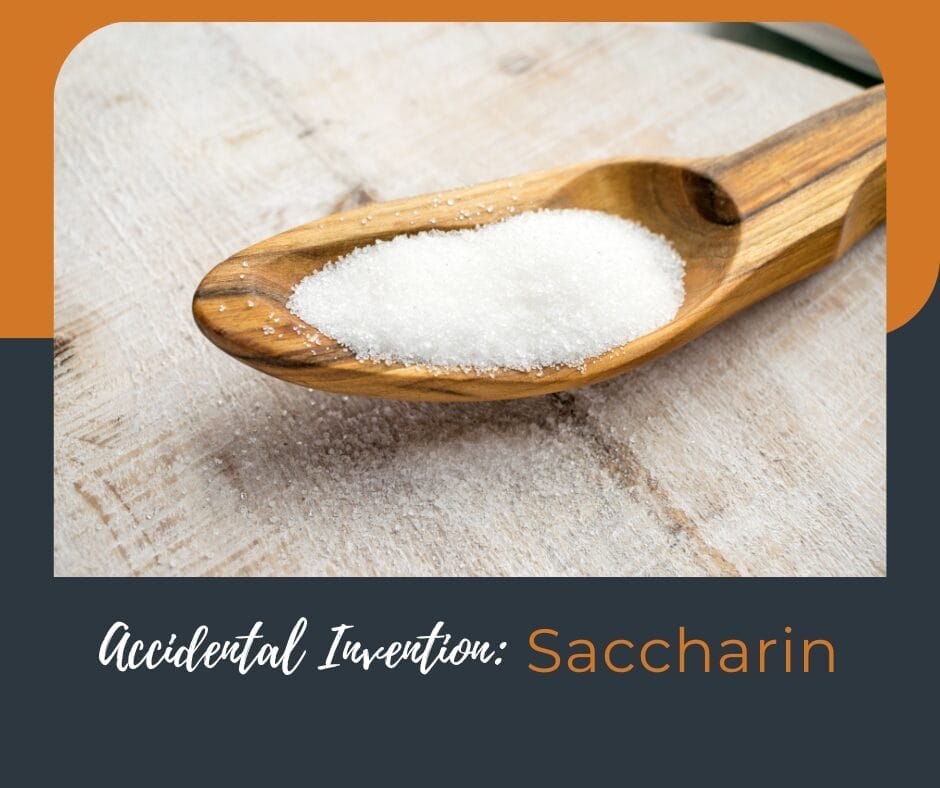
Accidental Invention: Saccharin

If you’ve ever looked through a collection of sweeteners for your coffee or tea, you’ve probably found several packets in various colors. But do you know what is actually inside? The pink one contains saccharin – a zero-calorie sugar alternative that was a surprisingly serendipitous result of laboratory experimentation 150 years ago.


A substance that is 200 to 700 times sweeter than sugar, saccharin was the first-ever sugar substitute and has been commonly used as a calorie-free beverage additive for decades. Though there has been much debate about its potential health impacts, saccharin has continued to be one of the most popular artificial sweeteners on the market.

A Sweet Surprise

In 1876, American chemist Ira Remsen returned from Munich and Gottingen University in Germany where he studied sulfobenzoic acids and subsequently established the first chemistry department at the newly-established John Hopkins University in Baltimore. A year later, the firm of William H. Perot & Co. hired German chemist Constantin Fahlberg to conduct an advisory examination of a shipment of demerara sugar that was alleged to have been artificially darkened to avoid higher import taxes, with arrangements for him to work in Remsen’s laboratory. After completing his analysis, Fahlberg received permission to stay at the university, and began researching coal tar derivatives alongside Remsen and his team.

One day, after returning home from the lab, Fahlberg noticed the piece of bread he was eating tasted exceptionally sweet. However, he quickly realized that it was not actually the food that was sweet, but his hands. So, he returned to the lab and tasted all of his beakers, glasses, and bowls until he determined which substance was the source – an oxidation of ortho-toluenesulfonamide that created benzoic sulfimide, which he called saccharin, meaning “of or resembling sugar.”

Sweeter than Sugar

Over the next few years, Fahlberg and Remsen co-authored an article describing the synthesis of saccharin, highlighting that the compound was miraculously “sweeter than cane sugar.” Though Remsen did not like the concept of industrial chemistry, Fehlberg recognized the commercial potential of his discovery and applied for both German and American patents to cheaply produce the substance in larger quantities. Despite Remsen’s protests, Fahlberg was awarded a US patent in 1886 and began manufacturing saccharin in pill and powder forms, marketing them as beverage additives.

Before too long, however, competitors and consumers began having concerns about consuming saccharin and, with the release of Upton Sinclair’s The Jungle in 1906, Americans began to demand action in response to food-industry horror stories. As a response, Harvey Wiley, head chemist of the US Department of Agriculture, proposed the first saccharin ban, believing that it could not possibly be safe. This was quickly shot down by President Theodore Roosevelt, who was given a prescription from his primary physician for the substance as a weight-loss strategy, stating “Anyone who says saccharin is injurious to health is an idiot. Dr. Rixey gives it to me every day.”

Sickly Sweet

Eventually, in 1912, saccharin was banned for use in food manufacturing, but it was still available as a standalone product, continuing to be a desirable “non-fattening” alternative for diabetics and those looking to cut calories. Soon, it became an even more popular substitute due to sugar shortages during the World Wars. In the 1960s, saccharin gained even more traction as American interest in weight loss continued to grow, and the recognizable brand Sweet’n Low was created.

Several studies conducted on rats in the following years suggested a link between saccharin and bladder cancer, leading to the Saccharin Study and Labeling Act of 1977, which required products containing the ingredient to have a warning label stating it may be hazardous to the health of consumers. However, later findings concluded that those results were irrelevant because humans metabolize the chemical differently, and it was removed from the potential carcinogens list in 2000, rescinding the packaging regulations.

Though there has been continued controversy about artificial sweeteners, the discovery of saccharin opened the doors for new innovations that have provided numerous alternative choices for individuals looking for low-calorie sugar substitutes. As consumer preferences continue to trend towards “lighter” and healthier options, it’s likely that artificial sweeteners will remain significant in the food and beverage industry for years to come.

If you enjoyed this tale of accidental innovation, check out similar stories about Corn Flakes, potato chips, and penicillin.


To learn more about Custom Powder Systems and the art of engineering, sign up for our newsletter.