

Imagine you’ve just flown a quarter-million miles to the moon to collect some rock samples that every scientist on the team is eager to get ahold of. However, you need to figure out a way to let them get their hands on them… without letting them actually get their hands on them.
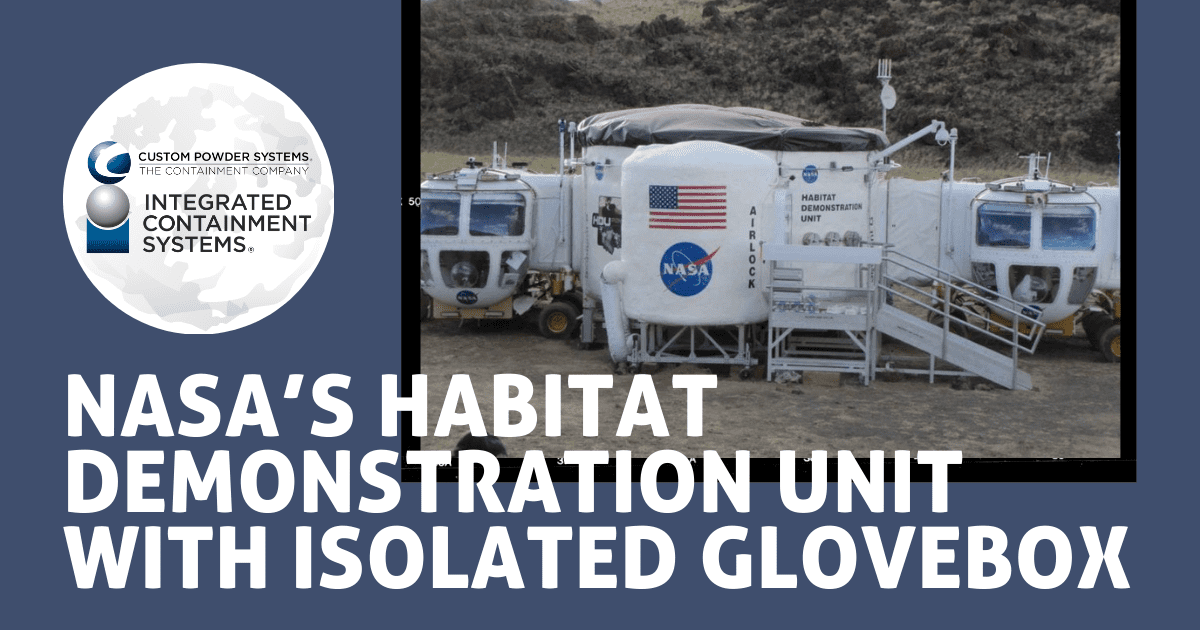
The Habitat Demonstration Unit (HDU) is a combined effort from NASA architects, scientists, and engineers, looking to develop sustainable living quarters, workspaces, and laboratories. It even includes a custom isolator glovebox made by Integrated Containment Systems (ICS). The HDU (also called the Geo-Lab work center) is a prototype designed for next-generation space missions allowing laboratory research to be performed in real-time while still onsite.
The Technology Behind the Glovebox
According to Russel Kraniak, our now retired Head of Technology and former member of the Board of Directors of the American Glovebox Society, “The technology came from the nuclear industry. When they were manufacturing the bomb and working with plutonium and tritium, they needed a way to do their machining without being exposed to those materials.”
Soon after, this technology was used in the pharmaceutical, electronics, and food industries to not only protect workers from the materials but also protect the materials from human contamination. As it turns out, we’re all crawling with deinococcus radiodurans: extremely resilient microscopic organisms that survive radiation, dehydration, and even the vacuum of space.
How did NASA solve the problem of lunar sample contamination?
Kraniak says when we brought back samples from the moon, “There was great excitement because they found moisture in the rocks. The problem was, there was no moisture in the rocks. They later determined the rocks somehow became contaminated from the time they were on the moon to the time they got back.”
In order to avoid sample contamination, the scientists need a way to examine the rocks while they’re still on the moon. Which is where ICS and the Geo-Lab work center come in: “Astronauts could get the sample, open up a port, stick a rock in there, and physically examine it on the moon,” says Kraniak, “because all the equipment is in that special glovebox.”
Untouchable Lunar Challenges
In addition to physically holding the samples, lunar scientists also have to be able to examine the moon rocks with microscopes and other equipment without contamination.
“The microscopes had to be able to get a clear visual of the element in the box, without being inside the box,” notes Kraniak. “We saw that other glovebox suppliers hadn’t done mock-ups to see how it all went together. So we built a mockup with plywood and plexiglass to take into consideration how much space was needed. We wanted things to be small enough, yet big enough to do what they wanted to do.”
And, surprisingly enough, this advanced device for NASA is actually one of the “easier” projects taken on by Integrated Containment Systems. A recent earthbound project in Iowa was a tremendously intricate build that involved thousands of pages of specifications.
What are the future plans for the Habitat Demonstration Unit?
While the Habitat Demonstration Unit still lives on earth, the plan is for it to be a part of upcoming lunar missions. As advancements continue in space exploration, it’s possible we may also see this invention head up to Mars.
We love solving problems for earthlings and martians alike, and are excited to make something great for you!
_________________________________________________________________________
To hear more about the art of engineering, sign up for our newsletter.


