ASME U-Stamp importance highlighted visually

What ASME U-Stamp Accreditation Really Means (and Why Buyers Ask for It)

The question behind the question

When a buyer asks, “Are you ASME certified?” they’re rarely asking for a badge. What they’re really asking is:

  • Can I trust this vessel to perform safely for the long haul?
  • Is the fabrication process controlled and repeatable?
  • If something goes wrong years from now, can we track exactly what happened and why?
  • Has anyone outside the shop verified it was built the right way?

That’s where ASME accreditation comes in.

ASME in plain language

ASME (American Society of Mechanical Engineers) publishes widely adopted codes that define how pressure vessels must be designed, built, welded, inspected, and documented.

The biggest difference between “standard fabrication” and “ASME work” is that ASME requires you to prove what you did—with documentation that’s detailed enough to trace critical aspects of the build long after the vessel leaves the shop.

In other words: it’s not just about building it. It’s about being able to show your work.

What “Section VIII U-Stamp” means

For pressure vessels, a common accreditation is:

  • ASME Section VIII – the rules for building pressure vessels (non-boiler)
  • U-Stamp – the stamp applied to qualified pressure vessels built under Section VIII

Section VIII work applies to vessels intended to hold pressure above 15 PSI and/or negative pressure (vacuum) applications. The stamp is a signal that the vessel was built under code and met the requirements for documentation, inspection, and control.

What “Section IX” has to do with it

Pressure vessels are only as good as the welds that hold them together. ASME Section IX governs welding procedure qualification and related requirements. It helps ensure weld quality is not dependent on “who happened to weld it that day,” but is consistent, validated, and repeatable.

Why third-party inspection matters

One of the most important points from your transcript is that ASME work isn’t just “checked in-house.”

A third party—through an Authorized Inspector (AI)—provides independent oversight. That inspector:

  • Reviews key documentation (including design calculations in many cases)
  • Verifies that the build is following the rules of the code
  • Adds confidence for the customer that it wasn’t simply “approved internally”

For buyers, this matters because it reduces risk. It’s one thing for a shop to say “we build good vessels.” It’s another thing to have an outside authority confirm the vessel was built under a known standard.

The big value: traceability

ASME work is built around traceability:

  • Materials are tracked
  • Weld procedures are documented
  • Inspection records are captured
  • Non-destructive testing (NDE) results can be included as required

That traceability is what makes ASME so attractive to regulated industries like pharma and food & beverage, where documentation is often just as important as the equipment itself.

“Built to code” vs “Stamped”: what’s the difference?

You’ll often hear two options:

1) Built to code (not stamped)
This typically means the shop follows code-based methods and documentation practices for the build, but the vessel is not registered/stamped as an official code vessel.

2) Stamped (U-Stamp)
This is the full code vessel path. It usually involves:

  • More formal documentation
  • Authorized inspection involvement
  • Additional review and verification steps
  • A higher overall project cost

So yes—a stamped vessel typically costs more. Not because it’s gold-plated, but because there are more checks, more documentation, and more stakeholders required to meet the code requirements.

How ASME helps customers—and the shop

From a customer standpoint, ASME helps with:

  • Reduced safety and compliance risk
  • Stronger commissioning/qualification documentation
  • Long-term accountability and traceability

From a shop standpoint, ASME can expand where the company can compete:

  • More projects in regulated industries
  • More complex vessel applications
  • More trust in competitive bid scenarios

And in regions with lots of stainless and vessel fabrication, buyers often use ASME as a screening factor because it’s hard to obtain—and even harder to maintain.

Is ASME important to your equipment purchase

ASME accreditation isn’t a marketing line. It’s a manufacturing discipline.

ASME accreditation is ultimately about reducing unknowns. It gives you a build standard you can point to, a documentation trail you can rely on, and an outside set of eyes that helps ensure the vessel you receive matches the requirements you specified. Whether you’re handling powders in a regulated environment or you simply want tighter control over quality and traceability, the right approach—built to code or fully stamped—can save time, risk, and rework down the road.

If you’re planning a new vessel or upgrading an existing process at Custom Powder Systems, our team can help you decide what level of code compliance makes the most sense for your application. Tell us what you’re containing (material type, pressure/vacuum needs, and your industry requirements), and we’ll walk you through the best path—no overbuilding, no guesswork—just the right solution for your process.

pass through container

“That’s the Strangest Thing I’ve Ever Seen”

Just when you think you’ve seen it all, something new comes along.  One that made our Denise McIntosh say, “What is that?  That’s the strangest looking machine I’ve ever seen!”

It’s another innovation from the smart minds in our engineering department. The challenge they encountered was a customer who needed to get product from one room into another. That’s easy. The problem was the wall.

When an unstoppable force meets an immovable object, you have an engineering paradox. But not for the engineers at Custom Powder Systems. When we ask them to walk through walls for our customers, they do exactly that.

This fascinating device is a pass-through wall transfer system. The idea is to get a product from one room to another without handling it.  

We always love a good challenge. While we have many products like containers/IBC, isolators, and blending machines that are ready to go for any application, we have a long history of breaking through walls that would stop other companies.

Some people see what we come up with and call it a magic trick. We just see good engineering and proactive problem-solving.

What “walls” are stopping you from being your most efficient? We’ve solved space problems, streamlined overly complex processes, and just straight-up invented things nobody has ever seen before.


Contact us here or simply call 417-868-8002.  Send a challenge our way and we’ll literally go through walls for you

2020-06-08_14-05-32

CPS Abides: Embracing Constraints to Adapt and Thrive in this Ever-Changing World

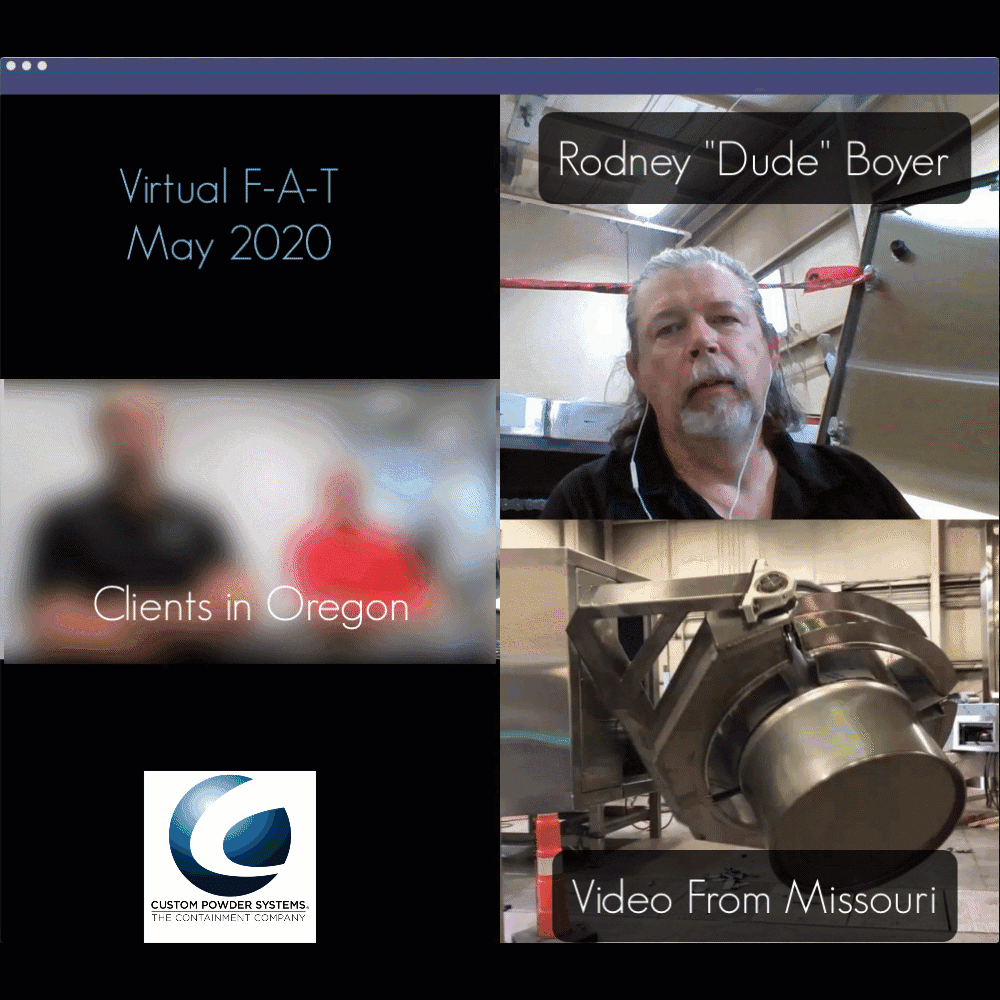
In nearly every way, it was an F-A-T like any other… we demonstrated the functionality of the new, custom, dry material handling blender as the client looked on. We walked them through every step of its operation and answered their question, and the meeting ended with a successful test.

Except… in one major way, it was nothing like the hundreds of tests we’ve performed for clients around the world over the last fifteen years.

The clients were 1,968 miles (3,167 kilometers) away. It took place online.

The client was in Oregon, connected via Microsoft’s Teams application, and Rodney Boyer (any resemblance to Jeff Lebowski is purely coincidental), Senior Automation Engineer for CPS was leading the client through the F-A-T while his Vanna White assisted. In this case, the role of Vanna was played by CPS’ own Bob Luebbe, Senior VP of Sales, who manned a camera phone also connected to Teams.

“In many ways, it’s the same as it ever was,” said Boyer. “We’re able to send the documentation ahead of time then securely walk them through the functionality as if they were in the room with us.”

Boyer, Luebbe, and the team at Custom Powder have been embracing constraints since the conception of the company in June of 2005.

“Everyone on the team enjoys the brainstorming part of this,” says Luebbe. “We love it when companies come to us unsure of how something can be done. For us, virtual FATs were just a natural result of our culture of brainstorming around obstacles.”

With so many of their colleagues and peers headquartered overseas facing strict travel restrictions, Custom Powder’s ability to travel easily anywhere in the United States combined with their unique ability to consider—and even invent—alternative solutions has made their team indispensable to their clients.

I’d argue there’s really no such thing as business-to-business. It’s all people doing business with other people.

Denise McIntosh, CEO, Custom Powder Systems

“Yes, of course we are in the dry material handling business, but more than that, we’re in the relationship business,” says Denise McIntosh, CEO of Custom Powder Systems. “In fact, I’d argue there’s really no such thing as business-to-business. It’s all people doing business with other people.”

“I really enjoy working hand-in-hand and face-to-face with our clients,” said Boyer, “but when that’s not an option in the current climate, it’s nice to know we can still help them solve problems.”

“Our team is hard-wired that way,” added Luebbe, “to embrace constraints and brainstorm solutions to these new problems that, so far, seem to be defining 2020.”

Watching the satisfied clients disconnect from Teams after a successful F-A-T, it’s easy to see why Custom Powder continues to redefine how it spells S-U-C-C-E-S-S.

If you’re looking for a US-based company to help you embrace constraints and save you time and money with creative solutions, contact Custom Powder Systems today.

CPS + MSHP: The Power of Positive Relationships

CPS + MSHP: The Power of Positive Relationships

At Custom Powder Systems, we understand the power of positive relationships. Sometimes, though, we’re surprised at how they start. We’ve been fortunate to build a lasting, meaningful relationship with the Missouri State Highway Patrol, and it all began with a car crash.

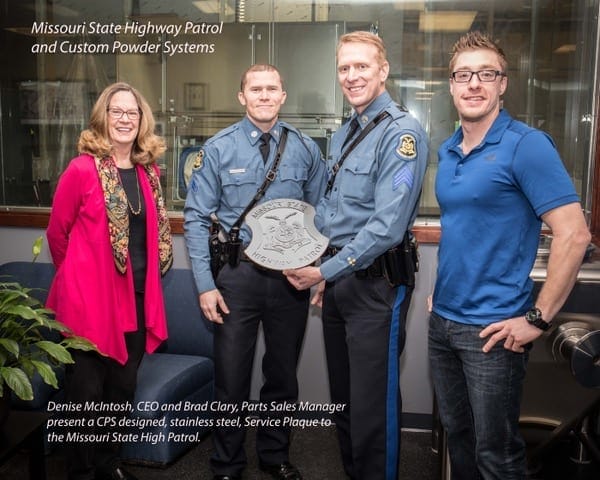
You see, a few years ago, we asked the Missouri State Highway Patrol (MSHP) to come and visit us as part of our own Safety & Wellness Program. We’d heard that the Patrol had a crash simulation trailer that would demonstrate what it felt like to be in a car wreck. The good folks at the MSHP donated their time to come to Custom Powder, and as our way of saying thanks, we decided to make a pair of plaques to present to them.

We’re no strangers to unique requests here at Custom Powder. And, to be frank, we like using the tools in our shop. We had taken delivery of our first water jet machine, and we had a skilled operator who chose to go above and beyond by designing the plaques from scratch.

image3

We were happy with the end result, and as luck would have it, those plaques were quite a hit. They gathered a lot of attention at the Patrol’s Christmas party, where they were given away as prizes. Soon after, we started seeing requests for other MSHP projects, and we were happy to help.

Over the years, it has been our privilege to work with the Patrol on their custom projects. It’s not only our way of giving back to those who serve our local communities, but it’s also a great way to develop lasting relationships. The Patrol’s requests have ranged from signs for their Communications department to a retirement plaque for Lt. Dan Bracker that you can see in the photo below. But none of those were as meaningful as being able to answer the call for a memorial wall project.

image2

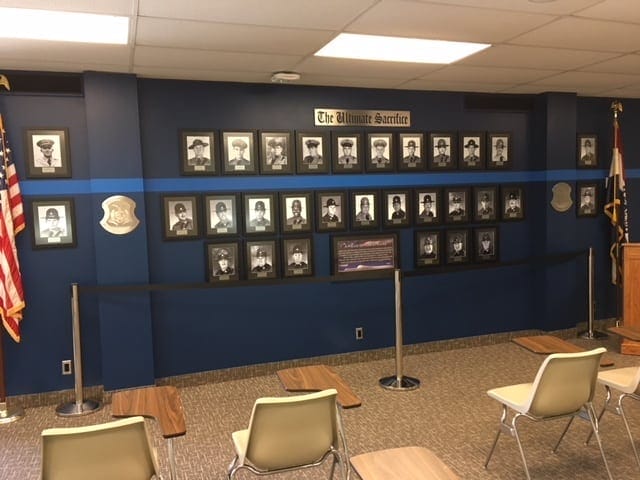
Back in 2015, the team from Troop D of the MSHP asked us to create some finishing touches for their memorial to fallen officers. We were proud to work with them to develop two MSHP emblems and signage for the wall that reads The Ultimate Sacrifice. Since then, the idea has spread and now there are Ultimate Sacrifice walls in other Troop offices around the state.

image1

We were proud to play even a small part in honoring those who gave their all in the line of duty. But we were also humbled. When you work with companies from around the world, it’s nice to have a chance to do good at home.

While we’re pretty fond of the name Custom Powder Systems, we’re not afraid to take a step off the beaten path to help out a friend. Whatever your company’s needs, drop us a line. Let us develop a custom solution for you.